

The AI promise is accelerating. The operational gap is widening.
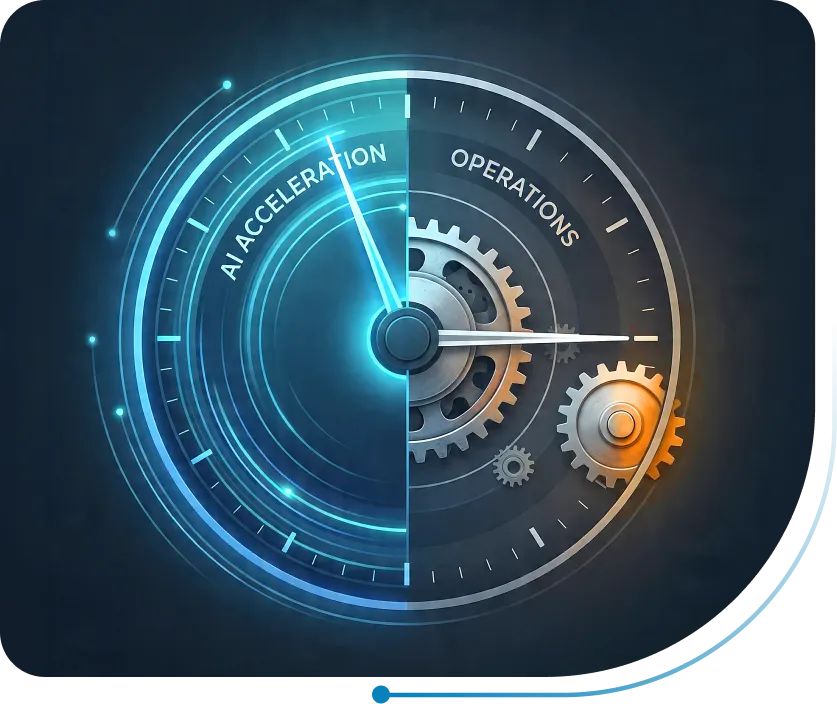
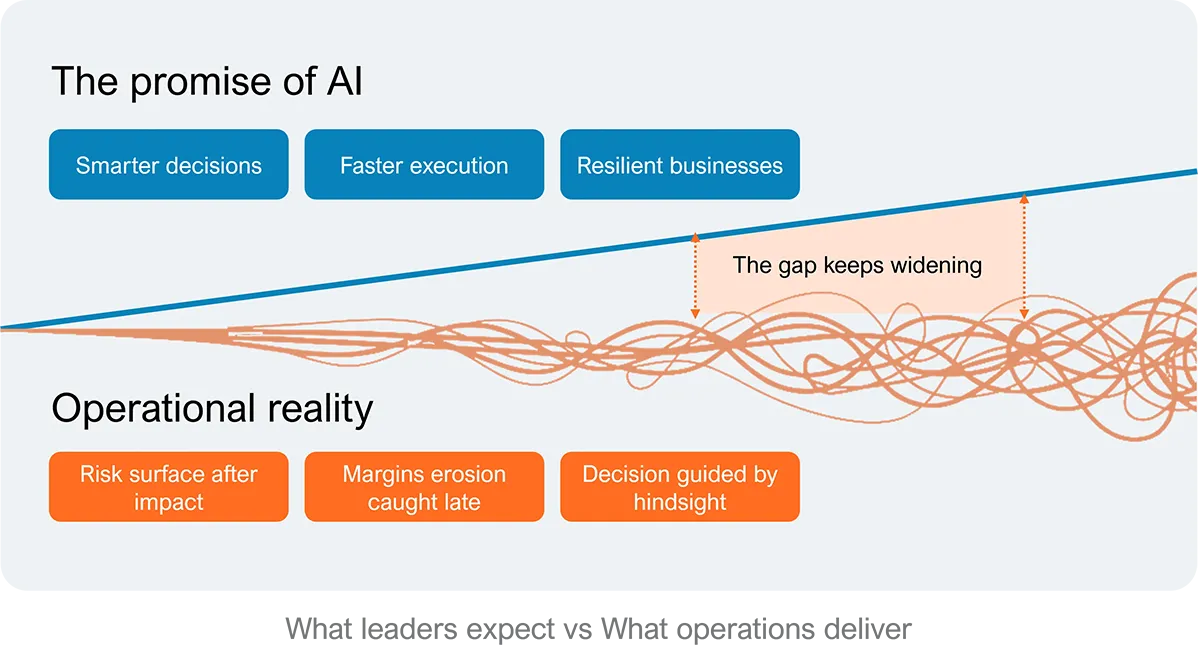
The promise of AI is compelling – smarter decisions, faster execution, more resilient businesses. But for most service-centric firms, the reality looks different.
Reality check
Operational reality hasn't kept pace
AI investment is rising. Expectations are higher than ever. Yet delivery risk is still discovered too late. Margins are still protected reactively. Leaders are still navigating complexity using lagging indicators.
The issue isn’t effort. And it isn’t technology. It’s that the operating model was never designed for machine-coordinated intelligence.
The cascade effect
As complexity grows, orchestration becomes critical
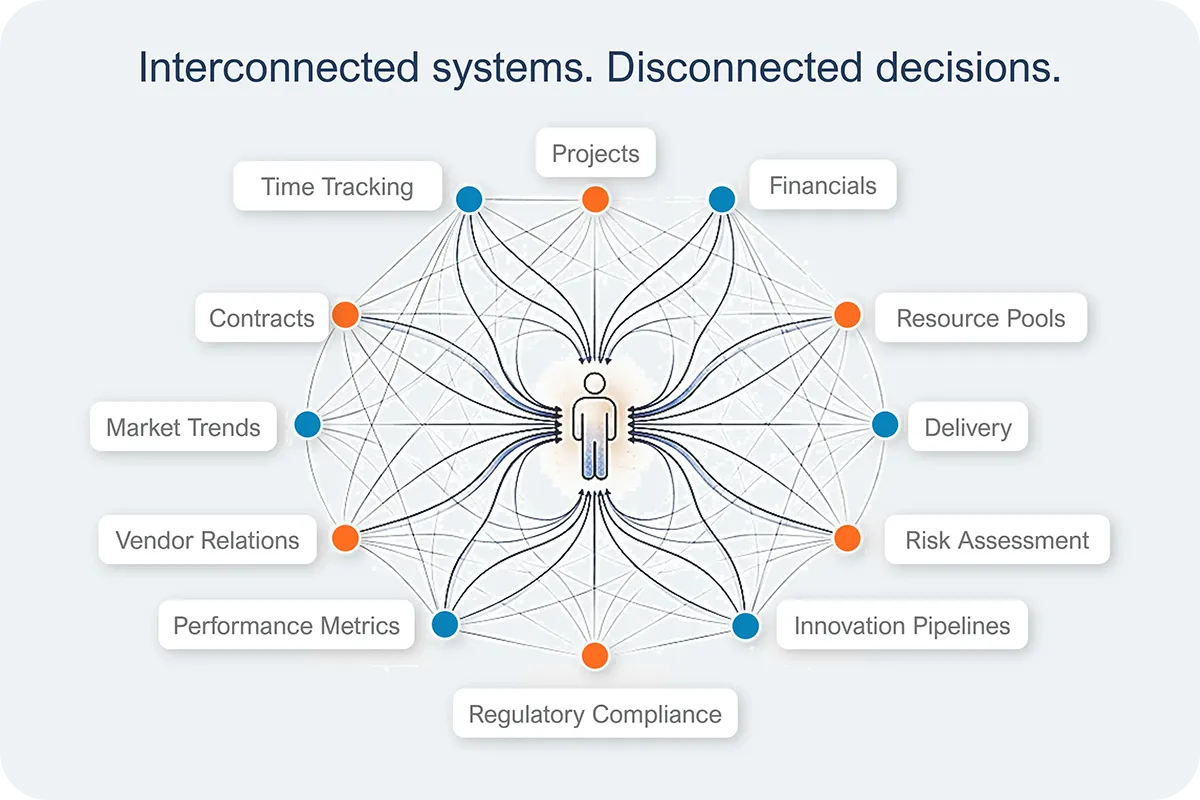
Service-centric firms operate across interconnected projects, distributed teams, and tightly coupled financial and delivery models.

Projects influence margin.
Margin influences resource allocation.
Resource allocation affects client experience.
Client experience affects future growth.
Yet most operational decisions are still human-led, retrospective, and dependent on someone noticing a problem. As complexity increases, human-only orchestration becomes the bottleneck.
Productivity gains are only the beginning
Copilots and chat interfaces are useful. They help individuals work faster. But service-centric firms don't struggle because people lack information. They struggle because systems don't act early enough.
Data and decisions
Disconnected data, fragmented decisions
Modern enterprises run on multiple systems of record – CRM, finance, project management, resource planning, compliance platforms. Each captures a dimension of performance.
But none captures the whole operating picture.
Leaders have to rely on stitched-together reporting layers that reconcile historical data. This creates three structural problems:
This is not a data volume issue. It is a systems-coordination issue. Without a unified operational view that AI can reason across, intelligence remains fragmented.
Governance
Trust cannot be optional
In service-centric environments, client confidentiality, regulatory compliance, and financial integrity are foundational. AI systems introduce new forms of exposure:
AI exposure risks
Data residency questions
Where does sensitive data travel when AI processes it?
Permission inheritance challenges
AI agents may access data that humans wouldn't be permitted to see.
Unclear auditability of automated decisions
Can you explain why the AI made a specific recommendation?
The result
Pilots remain pilots
Without governance alignment, AI never moves to production.
Automation remains advisory
AI gives recommendations; humans must still action every one.
Responsibility remains human
Full accountability stays with people, nullifying the scaling benefit.
AI cannot become operational infrastructure unless it aligns with the enterprise's security and permission architecture. Trust is not a feature; it is a prerequisite.
Scalability
Scaling intelligence across a heterogeneous environment
Growth pressure exposes architectural limits. Most enterprises operate a mix of ERP and CRM systems, industry-specific tools, custom workflows, and emerging AI point solutions. Each tool may improve a function. Few improve orchestration across functions. This creates two structural bottlenecks:
Intelligence does not travel across systems.
Automation cannot complete transactions end-to-end.
Scalability is not only about headcount. It is about whether your environment can absorb new intelligence without creating more fragmentation. If every AI capability becomes another isolated layer, complexity compounds rather than reduces.
True scalability requires governed extensibility – the ability to integrate new intelligence without destabilizing the operating core.


Context matters
Intelligence cannot be generic
Service-centric firms differ fundamentally from product models. Margin is shaped by utilization patterns, billing structures, contract risk allocation, resource mix, and client behaviour over time.
Generic AI models may interpret data statistically, but they do not inherently understand these structural relationships. Without contextual grounding, AI produces insight without consequence.
Operational intelligence must be anchored in how the business actually makes money; not just in how data is structured. When AI speaks the language of the industry, it can move from commentary to decision support.
The strategic shift
From answering questions to anticipating outcomes
Today’s AI tools are designed to respond. They provide summaries, draft content, and answer queries quickly. But operational risk rarely announces itself through a prompt.
Reactive
Query-based support
- Someone notices a problem and asks a question
- AI provides a summary or draft response
- Human interprets and decides what to do
- Response happens after the damage is done
Proactive
Predictive orchestration
- Detecting margin drift before quarter close
- Identifying resource misalignment before schedule impact
- Recognizing client dissatisfaction before escalation
- AI that acts without waiting to be asked
The root cause
These are not isolated challenges. They share a common root.
Most enterprises were designed for human coordination across systems of record. AI has largely been layered on top of that structure.
Without redesigning how intelligence flows and actions are triggered, organizations see incremental gains, not operational transformation.
The shift now is toward operational AI – intelligence designed to run the business, not just assist it.

See how leading organizations are responding
sa.global is helping service-centric organizations apply AI as an operating capability – grounded in industry context and built for enterprise scale.